
Rebrand vs Refresh: Which Does Your Business Need?
brand refresh vs rebrand may need a change, but does that mean starting from scratch or improving what you already have? Understanding rebranding vs brand refresh can help you make the right decision, protect your brand equity, and invest your budget where it matters most.
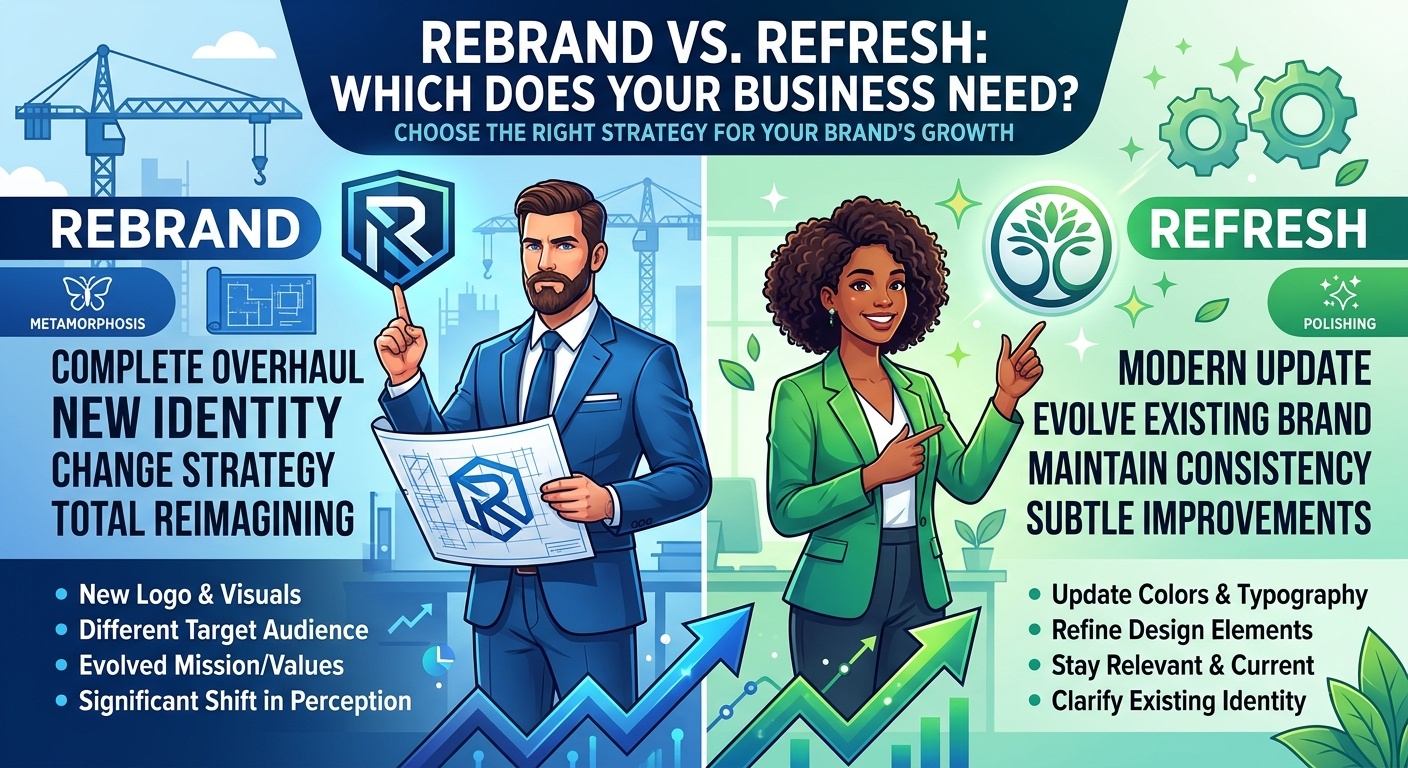
A brand refresh can modernise your visual identity while keeping your existing brand recognisable. A full rebrand can involve a deeper transformation of your positioning, messaging, identity, and customer perception.
Choosing the wrong approach can waste money, confuse loyal customers, and create unnecessary work. In this guide, we explain the difference between a rebrand and a brand refresh, compare their costs and risks, and share five questions to help you decide which approach is right for your business.
What Is a Brand Refresh?
A brand refresh is the process of updating an existing brand to make it feel more modern, relevant, and consistent without changing its fundamental identity.
The goal is to improve how your business looks and communicates while preserving the recognition and trust you have already built.
A typical brand refresh may include:
-
Refining your existing logo
-
Updating your colour palette and typography
-
Improving website design and user experience
-
Modernising photography, illustrations, and graphics
-
Updating brand guidelines
-
Improving tone of voice and marketing materials
-
Creating a more consistent identity across digital platforms
When Does a Brand Refresh Make Sense?
A brand refresh may be the right choice when your business strategy remains strong, but your presentation feels outdated.
For example, a successful professional services company may have a trusted logo and a loyal customer base, yet its website looks old-fashioned and its marketing materials lack consistency. Updating the visual identity can make the company feel more contemporary without losing its established reputation.
What Is Rebranding?
Rebranding is a more substantial process that changes how a business presents, positions, or differentiates itself in the market.
Unlike a simple visual update, business rebranding may involve redefining the brand’s purpose, audience, positioning, messaging, name, visual identity, and customer experience.
A full rebrand may include:
-
Brand strategy and market research
-
New positioning and value proposition
-
Audience and competitor analysis
-
A new brand name or tagline, where necessary
-
A redesigned logo and visual identity
-
Updated messaging and tone of voice
-
Website redesign and content migration
-
New marketing and sales materials
-
Updated packaging, signage, and digital assets
-
A launch and communication strategy
When Is a Full Rebrand Necessary?
A full rebrand may be appropriate when your business has changed significantly or its current identity no longer reflects what it offers.
Common reasons include entering a new market, targeting a different audience, merging with another company, changing business models, or overcoming a serious mismatch between brand perception and business reality.
For example, a company that began as a local web design studio but has evolved into an international digital product consultancy may need more than a new logo. Its positioning, messaging, services, and visual identity may all need to change.
Rebranding vs Brand Refresh: What Is the Difference?
The main difference between a rebrand and a brand refresh is the depth of change. A refresh improves the existing brand, while a rebrand redefines some or all of its strategic identity.
| Factor | Brand refresh | Full rebrand |
|---|---|---|
| Main goal | Modernise the existing brand | Change market perception or positioning |
| Brand strategy | Mostly retained | May be substantially revised |
| Logo | Refined or updated | May be replaced entirely |
| Colour and typography | Updated or improved | May be completely redesigned |
| Brand name | Usually unchanged | May change if strategically necessary |
| Messaging | Refined | May be rewritten |
| Customer recognition | Generally preserved | May need to be rebuilt |
| Cost | Usually lower | Usually higher |
| Risk | Generally lower | Generally higher |
| Timeline | Often shorter | Often longer |
The right option depends on your business objectives, not simply how old your logo looks.
Brand Refresh vs Brand Redesign: Are They the Same?
A brand redesign usually focuses on changing the visual elements of a brand, such as its logo, typography, colour palette, and graphic system.
A brand refresh can include a visual redesign, but it may also involve improving messaging, brand consistency, and the way the business communicates.
For example, redesigning a logo without changing the company’s positioning is primarily a visual redesign. Updating the logo, colours, website, and messaging while retaining the same strategic direction is more accurately described as a brand refresh.
A complete rebrand goes further when the business needs to change its fundamental market position, identity, or customer promise.
Rebrand vs Rebranding: Is There a Difference?
The terms rebrand and rebranding are closely related and are often used interchangeably.
-
Rebrand can refer to the overall transformation or the new identity itself.
-
Rebranding describes the process of changing how a business presents and positions itself.
-
Brand refresh describes a more limited update that retains the brand’s core identity.
For example, a business might decide to rebrand after a merger. The research, strategy, design, and launch activities involved are part of its rebranding process.
Refresh or Rebrand? Answer These 5 Questions
Use this decision framework to determine whether your business needs a brand identity refresh or a complete rebrand.
1. Has Your Business Strategy Changed?
If your business still serves the same audience and offers the same core value, a refresh may be sufficient.
However, if you have changed your business model, entered a new industry, or shifted towards a different customer segment, a full rebrand may be more appropriate.
Ask yourself: Does our current brand accurately represent what we do today?
2. Do Customers Still Recognise and Trust Your Brand?
Brand recognition is valuable. If customers know your business, trust your reputation, and understand your offer, you may not need to discard your existing identity.
If your brand is associated with an outdated service, poor customer experience, or an irrelevant market position, deeper strategic changes may be necessary.
Ask yourself: Would changing our identity strengthen our reputation or risk confusing existing customers?
3. Is the Problem Visual or Strategic?
An outdated website, inconsistent typography, old-fashioned colours, or an unpolished logo often indicate a need for a brand refresh.
A confusing value proposition, weak differentiation, or a mismatch between your brand promise and actual services may indicate a need for rebranding.
Ask yourself: Do we need to look more relevant, or do we need to stand for something different?
4. Are You Entering a New Market or Targeting a New Audience?
If you are expanding geographically while retaining the same audience and business proposition, a refresh may work.
If you are moving from budget-focused consumers to premium enterprise clients, your positioning, messaging, service presentation, and visual identity may need a more substantial transformation.
Ask yourself: Will our current brand appeal to the people we want to reach next?
5. What Budget, Time, and Risk Can You Manage?
A brand refresh generally involves fewer changes and can be easier to implement across existing materials.
A full rebrand may require more research, design, legal checks, website development, content updates, and customer communication. It can also require a more extensive launch plan.
Ask yourself: Can we support the investment and operational work needed to implement the change properly?
Your Decision
-
Choose a brand refresh if your strategy is sound, customers recognise your brand, and the main issues are visual or consistency-related.
-
Consider a full rebrand if your positioning, audience, business model, or core brand promise has materially changed.
-
Consider a brand redesign if your main requirement is to update the visual identity without changing the wider strategy.
If your answers point in different directions, start with a brand audit. Research and customer feedback can help establish whether the problem is visual, strategic, or both.
Brand Refresh vs Rebrand: Cost and Risk Comparison
The total cost depends on the size of your business, the number of assets, research requirements, website complexity, and the scope of implementation.
| Cost or risk factor | Brand refresh | Full rebrand |
|---|---|---|
| Research | Usually limited | Often more extensive |
| Strategy | Existing strategy retained | Strategy may need redevelopment |
| Design work | Targeted updates | Broader identity development |
| Website changes | Visual and content improvements | Potentially a full redesign |
| Staff training | Usually limited | May be needed across teams |
| Customer communication | Explain the improvements | Explain the reasons for the change |
| Implementation risk | Lower in many cases | Higher if recognition or positioning changes |
| Budget predictability | Often easier to estimate | Can involve more uncertainty |
Which Option Costs More?
A full rebrand generally costs more because it may involve research, strategy, naming, identity design, website redevelopment, and a coordinated rollout.
A refresh can be more affordable when it is limited to visual improvements and selected marketing assets. However, a large refresh across multiple locations, products, and platforms can still require significant investment.
For a meaningful estimate, define the scope first: what will change, what will stay, how many assets need updating, and who will implement the changes.
What Are the Risks of a Brand Refresh?
A refresh can fail when the underlying business problem is strategic rather than visual. A more modern logo cannot solve an unclear value proposition or a poor customer experience.
Other risks include inconsistent implementation, unnecessary design changes, and failing to update all customer touchpoints.
What Are the Risks of a Full Rebrand?
A full rebrand can confuse existing customers if the transition is poorly communicated. It may also involve domain changes, search visibility fluctuations, new design and development costs, and the loss of familiar brand cues.
To reduce these risks, involve key stakeholders, test the new positioning, plan redirects for changed URLs, update brand assets systematically, and explain the reasons for the change to customers.
Realistic Example: Should a Growing SaaS Company Refresh or Rebrand?
Consider an anonymised example of a fictional B2B software company.
The company has operated for eight years and has a recognisable name among small-business customers. Its logo looks dated, its website is difficult to navigate, and its colours vary across marketing materials. However, its product offering, target audience, and core positioning remain relevant.
The recommended approach: a brand refresh.
The company retains its name and positioning while refining the logo, introducing a consistent colour system, improving typography, updating its website, and creating clear brand guidelines.
Now imagine that the same company decides to stop serving small businesses and becomes an enterprise automation platform. Its existing messaging focuses on affordability and simplicity, while its new audience expects security, integration capabilities, and enterprise-level support.
The recommended approach: evaluate a full rebrand.
The business may need new positioning, messaging, service architecture, and visual identity to communicate its new value proposition. A new name may be considered, but it is not automatically necessary.
These examples illustrate how the right decision depends on the underlying business change rather than the desire for a new look.
How to Plan a Successful Brand Refresh or Rebrand
Whether you choose a refresh or a complete transformation, a structured process helps keep the work focused.
Step 1: Audit Your Existing Brand
Review your logo, website, messaging, social media profiles, customer feedback, sales materials, and competitors. Identify what works and what needs improvement.
Step 2: Define Your Objectives
Set clear goals, such as improving brand consistency, appealing to a new audience, communicating a new service offering, or strengthening differentiation.
Step 3: Research Your Audience
Understand what existing and prospective customers value. Use interviews, surveys, analytics, and competitor research to inform the decision.
Step 4: Choose the Right Scope
Determine whether the project requires visual updates, a broader brand refresh, or a complete strategic rebrand. Document what will change and what will remain.
Step 5: Develop and Test the Identity
Create the appropriate visual and verbal identity, test concepts with relevant stakeholders or customers, and ensure the brand works across digital and physical touchpoints.
Step 6: Implement and Measure
Roll out the changes consistently and monitor meaningful indicators such as brand recognition, website engagement, qualified leads, conversion rates, and customer feedback.
Compare performance against a baseline rather than assuming a new identity will automatically improve results.
Frequently Asked Questions
-
What is the difference between a logo and brand identity?
A logo is a visual mark that identifies a business. Brand identity is the wider system of elements, including the logo, colours, typography, imagery, and brand voice, that communicates the business's personality and creates consistency.
-
Can a startup succeed with just a logo?
Prices vary because designers offer different levels of research, creative development, customisation, revisions and support. A template-based logo and a strategically developed identity are different services, even if both deliver a logo file.
-
Is brand identity more important than a logo?
They serve different purposes. A logo helps people recognise your business, while brand identity helps communicate what your business represents. A strong identity includes a well-designed logo as one of its components.
-
How much does startup brand identity design cost?
Costs depend on the designer, location, scope, and deliverables. A logo-only package generally costs less than a comprehensive identity project that includes guidelines, messaging, and brand applications. Always review the proposed deliverables before comparing quotes.
-
Should I hire a logo designer or a branding agency?
A logo designer may be suitable if you need a specific visual asset. A branding agency can be a better fit if you need broader strategic direction, consistent messaging, a complete identity system, and support across multiple customer touchpoints.
-
Can I upgrade my logo into a complete brand identity later?
Yes. Starting with a logo and adding colours, typography, messaging, visual assets, and guidelines later is a practical approach for many startups. Choosing an adaptable logo from the beginning can make that process easier.
Ready to discuss your project? Contact Brands Design for a logo design quotation.
Get started with
Brands Design today
Ready to start your branding project? Get in touch
with our team to talk through what your business needs.