What Is Brand Identity? Elements, Examples and How to Build One
Every successful business needs more than a good product or service to stand out. It needs a clear identity that helps people recognise it, understand what it represents, and remember it when making purchasing decisions. This is where brand identity becomes essential.
From a distinctive logo and consistent colour palette to typography, imagery, and brand voice, every element contributes to how a business presents itself. When these elements work together, they create a recognisable and consistent experience across websites, packaging, social media, advertisements, and other customer touchpoints.
Whether you are launching a startup, growing an established company, or planning a rebrand, understanding brand identity can help you build a stronger presence in your market.
In this guide, we explain what brand identity is, how it differs from brand image and branding, which elements matter most, and how to build a distinctive identity for your business.
What Is Brand Identity?
Brand identity is the collection of visual and verbal elements a business creates to communicate its personality, values, purpose, and positioning. It includes the logo, colours, typography, imagery, messaging, and tone of voice that make a company recognisable.
Think of brand identity as the way your business introduces itself to the world. It communicates who you are, what you offer, and what customers can expect when they interact with your company.
For example, a luxury skincare brand might use elegant typography, neutral colours, minimal packaging, and refined language to communicate sophistication. A children’s toy company might choose bright colours, playful illustrations, rounded fonts, and friendly messaging to appeal to families.
Both businesses can have effective brand identities because their design decisions support their audiences and positioning.
A strong brand identity should be:
- Recognisable: Customers can identify your business across different channels.
- Consistent: Your logo, colours, typography, and messaging work together.
- Distinctive: Your business looks and sounds different from competitors.
- Relevant: Your identity reflects your audience’s needs and expectations.
- Flexible: Your design system works across websites, mobile screens, packaging, and print materials.
Brand identity is not simply about looking professional. It is about creating a coherent system that communicates what makes your business different.
Brand Identity vs. Brand Image vs. Branding
The terms brand, brand identity, brand image, and branding are often used interchangeably. However, each describes a different aspect of how a business establishes and maintains its position in the market.
Understanding these differences helps businesses develop more effective brand strategies.
What Is a Brand?
A brand represents the overall meaning, reputation, associations, and experiences people connect with a business, product, or service.
It includes what customers remember, what they expect, and how they feel after interacting with the company. A brand develops over time through its products, customer service, marketing, reputation, and public interactions.
For example, customers might associate a technology company with innovation, simplicity, reliability, or premium quality. These associations form part of its brand.
What Is Brand Identity?
Brand identity is the system a business deliberately creates to represent itself. It includes its logo, colour palette, typography, imagery, voice, and messaging.
A business has greater control over these elements because it can define its design standards and communication style.
For example, a company may choose a minimalist logo, a specific colour palette, and a clear, confident tone of voice to communicate professionalism.
What Is Brand Image?
Brand image is how customers and the wider public actually perceive a business.
Unlike brand identity, brand image cannot be completely controlled by the company. It develops through customer experiences, product quality, reviews, advertising, word of mouth, and other interactions.
For example, a company may position itself as customer-focused, but slow responses and unresolved complaints could lead customers to perceive it as unreliable.
What Is Branding?
Branding is the ongoing process of shaping how people recognise, understand, and perceive a business. It involves strategy, design, messaging, marketing, and customer experience.
Brand identity provides the elements a business uses to express itself, while branding brings those elements to life through consistent communication and experiences.
| Term | Meaning | Example |
|---|---|---|
| Brand | Overall reputation and associations | Customers see a company as reliable |
| Brand identity | Elements created to represent the business | Logo, colours, typography, and voice |
| Brand image | How people actually perceive the company | Customers consider it premium or affordable |
| Branding | Activities used to shape recognition and perception | Marketing, design, storytelling, and customer experience |
The key takeaway is simple: brand identity is what your business creates, brand image is how people perceive it, and branding is the ongoing work that connects the two.
Why Is Brand Identity Important?
A well-developed brand identity helps businesses communicate more clearly, stand apart from competitors, and deliver a consistent customer experience.
Here are the main benefits.
1. Builds Brand Recognition
Customers encounter hundreds of businesses through search results, advertisements, social media, and online shopping. A consistent identity makes it easier for them to recognise your business across these channels.
Repeated use of distinctive colours, typography, logos, and imagery helps customers associate those elements with your company over time.
2. Differentiates Your Business From Competitors
When several companies offer similar products or services, their identities can help communicate what makes each one different.
A carefully developed brand identity reflects your positioning and personality instead of simply copying current design trends.
For example, a sustainable clothing company might use natural photography, restrained colours, and transparent messaging to communicate its environmental priorities.
3. Creates a More Professional Impression
Consistent design across your website, business documents, social media, and marketing materials can make your business appear more organised and credible.
Customers may encounter your brand before speaking to anyone on your team. A clear, polished identity helps establish a professional first impression.
However, design alone cannot guarantee trust. Your products, service quality, and business practices must support the expectations your identity creates.
4. Creates a Consistent Customer Experience
Imagine visiting a company’s website and seeing minimalist design, then receiving an email filled with inconsistent colours, unrelated fonts, and a completely different tone of voice.
That experience can make the business feel disorganised.
A unified brand identity helps create continuity across every touchpoint, from the first advertisement to the checkout page and post-purchase communication.
5. Supports Marketing and Business Growth
When your brand identity is clearly documented, your team can produce new marketing materials more efficiently. Designers, developers, copywriters, and marketing professionals can follow the same standards instead of making unrelated decisions for each campaign.
As your business grows, this consistency becomes increasingly valuable across new services, product lines, locations, and digital platforms.
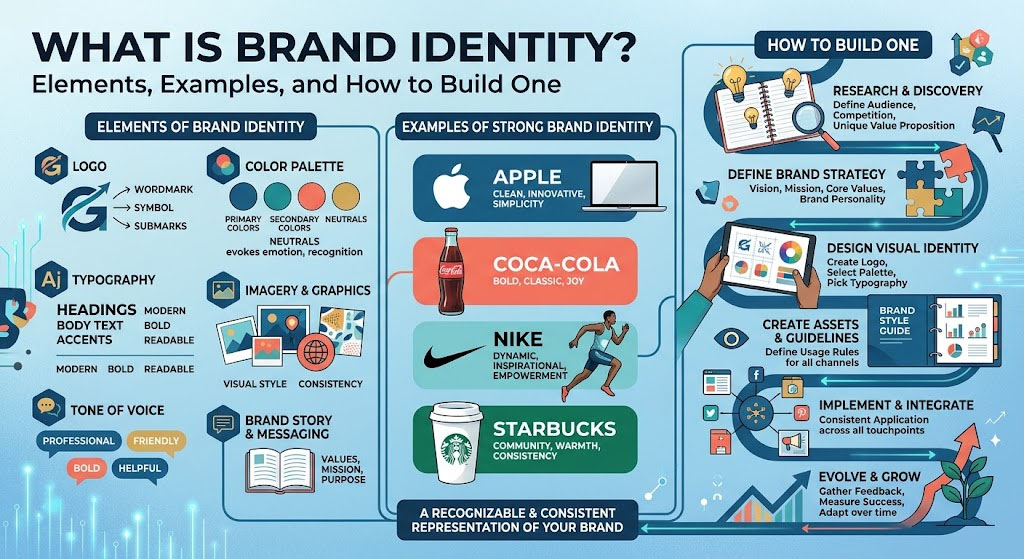
The 5 Key Elements of Brand Identity
A strong brand identity consists of several connected elements. Each one serves a different purpose, but they should all communicate the same underlying personality and positioning.
1. Logo Design
A logo is one of the most recognisable parts of a brand identity. It acts as a visual identifier that helps customers distinguish your business from others.
A logo may be a wordmark, symbol, monogram, combination mark, or another distinctive design.
An effective logo should be:
- Simple enough to recognise quickly.
- Distinctive within its industry.
- Readable and recognisable at different sizes.
- Suitable for digital and printed applications.
- Consistent with the brand’s personality.
For example, a corporate consultancy may choose a clean wordmark to communicate clarity and professionalism. A creative studio might use a more expressive symbol that reflects its personality.
A complete logo system may include a primary logo, a secondary version, an icon, and monochrome variations for different applications.
Important: A logo alone does not create a complete brand identity. It needs to work alongside colours, typography, imagery, and messaging.
2. Brand Colours
Colour plays an important role in visual recognition and can influence the impressions people form about a business.
A brand colour palette usually includes primary colours, secondary colours, neutral shades, and supporting colours for digital interfaces or specific campaigns.
For example:
- Blue is often used to communicate stability or professionalism.
- Green is commonly associated with nature, growth, or sustainability.
- Red can communicate energy, urgency, or boldness.
- Black and neutral palettes can support a refined or minimalist visual direction.
These associations are not universal. Their meaning depends on context, culture, industry, and how the colours are used.
When developing a palette, consider your target audience, competitors, accessibility, and the environments where the colours will appear.
For websites, ensure sufficient contrast between text and backgrounds. Define colour values using formats such as HEX, RGB, or CMYK as appropriate for digital and print applications.
3. Typography
Typography refers to the fonts and type styles a brand uses to communicate visually.
The right typography helps express personality while ensuring that information remains readable across different platforms.
For example, a luxury fashion brand may use an elegant serif typeface for editorial headings, while a software company may choose a clean sans-serif font for product interfaces and documentation.
A practical typography system should define:
- Heading and subheading styles.
- Body text and paragraph styles.
- Font weights and sizes.
- Line spacing and text hierarchy.
- Font usage across websites, presentations, and printed materials.
Most businesses can build a strong system with one or two complementary typefaces.
Consistency matters more than using many different fonts. A clear typographic hierarchy helps customers scan information and understand what matters most.
4. Brand Voice and Messaging
Brand voice defines how your business communicates through words. It includes the language, personality, tone, and messaging used across marketing and customer interactions.
A brand might sound professional, friendly, authoritative, playful, educational, or conversational.
For example, a financial consultancy may use precise, reassuring language to explain complex topics. A lifestyle brand might use warm, informal language to create a more personal connection.
To establish your brand voice, define:
- Personality: What three to five traits describe your brand?
- Vocabulary: Which words and phrases should your brand use?
- Tone: How should the brand sound in different situations?
- Messaging: What key ideas should customers remember?
- Tagline: Is there a short phrase that captures your promise or positioning?
Your tone can adapt to the situation without losing its underlying personality. A customer complaint may require more empathy than a social media announcement, but both should still sound like the same company.
5. Imagery and Graphic Style
Imagery includes photography, illustrations, icons, textures, patterns, shapes, and other graphic elements that support your visual identity.
A consistent imagery style helps communicate your brand’s personality even when the logo is not immediately visible.
For example, an outdoor adventure brand might use natural lighting, landscape photography, and authentic action shots. A premium interior design studio might use carefully composed architectural photography, generous whitespace, and subtle graphic details.
Your imagery guidelines should explain:
- What types of photographs to use.
- Whether images should feel candid, editorial, minimal, or highly polished.
- Which illustration and icon styles are appropriate.
- How graphics and patterns should be applied.
- Which image treatments or filters to avoid.
For digital brands, imagery should also be optimised for loading speed, mobile displays, and accessibility. Use meaningful alternative text for informative images and avoid relying on images alone to communicate essential information.
When these five elements work together, they form a recognisable visual and verbal system rather than a collection of unrelated design choices.
Brand Identity Examples From Successful Brands
Looking at established businesses can help explain how individual design elements contribute to a recognisable identity. The following examples illustrate different approaches to brand recognition and consistency.
1. Nike: A Distinctive and Simple Identity
Nike demonstrates how a simple visual symbol can become strongly associated with a business through consistent use.
Its recognisable Swoosh, athletic imagery, product presentation, and motivational messaging support a brand identity centred on sport, performance, and movement.
The lesson for smaller businesses is that a logo does not need to be complicated to be memorable. It needs to be distinctive, relevant, and consistently applied.
What businesses can learn: Build a visual system that remains recognisable across products, digital channels, packaging, and advertising.
2. Coca-Cola: Consistent Colours and Typography
Coca-Cola is widely recognised for its red-and-white visual palette, distinctive script logo, and familiar packaging.
These elements help create continuity across advertisements, bottles, retail displays, and other brand touchpoints.
The example shows why consistency matters. Repeated use of recognisable visual assets helps reinforce the connection between a business and its identity.
What businesses can learn: Choose a distinctive colour palette and typographic style, then use them consistently instead of redesigning every marketing asset from scratch.
3. Apple: Minimalism and Product Presentation
Apple’s identity is associated with a simple logo, restrained visual presentation, carefully composed product imagery, and clean digital experiences.
Its marketing and product communications frequently emphasise design, usability, and simplicity.
The lesson is not that every business should use minimalist design. Instead, the design direction should support what the business wants to communicate and what its audience values.
What businesses can learn: Remove unnecessary visual complexity and ensure that every design decision supports a clear purpose.
Applying These Lessons to Your Business
You do not need the resources of a global company to build a strong brand identity.
A startup can begin with a distinctive logo, a carefully selected colour palette, consistent typography, a defined voice, and a simple set of imagery guidelines.
The goal is not to imitate famous brands. It is to understand how consistency and a clear point of view make a business easier to recognise.
How to Build a Brand Identity Step by Step
Building a brand identity requires more than choosing a logo and colours. The strongest results begin with business strategy and continue through design, implementation, and evaluation.
Step 1: Research Your Audience and Competitors
Before making design decisions, understand the people you want to reach and the market in which your business operates.
Research your audience’s needs, preferences, challenges, expectations, and purchasing behaviour.
Review competing businesses to understand how they position themselves, communicate their value, and present their visual identities.
Look for opportunities to differentiate your business without becoming confusing or irrelevant to your industry.
Questions to consider include:
- Who is our ideal customer?
- What problems are we solving?
- What matters most to our audience?
- Which competitors are customers considering?
- What can we offer or communicate differently?
This research gives your brand identity a clear foundation.
Step 2: Define Your Brand Strategy
Your brand strategy establishes what your business stands for and how it should be positioned.
Start by defining your mission, values, purpose, audience, and unique value proposition.
For example, a small business specialising in custom furniture might focus on craftsmanship, durable materials, personalised service, and timeless design.
These priorities can guide the visual and verbal decisions that follow.
Create a short positioning statement that explains who you serve, what you offer, and why your business is different.
A useful starting template is:
“Our business helps [target audience] achieve [desired outcome] through

Best UI/UX Design Solutions for Mobile Apps, Websites & Dashboards
This statement does not need to appear publicly in exactly this form. Its purpose is to keep your internal decisions aligned.
Step 3: Establish Your Brand Personality and Voice
Choose three to five traits that describe how your business should appear and sound.
For example, a technology startup might choose:
- Clear.
- Innovative.
- Approachable.
- Reliable.
- Practical.
Next, define how these traits influence your messaging. An approachable brand may use straightforward language, while a premium brand may prefer a more restrained and editorial tone.
Write sample headlines, website introductions, product descriptions, and social media captions to test whether the voice feels consistent.
Document the words, phrases, and communication styles that fit your brand, along with examples of what to avoid.
Step 4: Develop Your Visual Identity
Once your strategy is clear, translate it into a visual system.
Start with logo design, then develop the colour palette, typography, imagery direction, graphic elements, and layout principles.
Evaluate the system across realistic applications rather than judging each component in isolation.
For example, preview your identity on:
- A desktop website and mobile screen.
- Social media profiles and posts.
- Business cards and presentations.
- Product packaging or labels.
- Email signatures and marketing materials.
Make sure the identity remains recognisable at different sizes and works in both colour and monochrome where needed.
The objective is to create a flexible system that reflects your business and remains practical to use.
Step 5: Apply Your Brand Identity Across Every Touchpoint
A brand identity becomes useful when customers experience it consistently.
Apply your design and messaging standards to your website, landing pages, social media accounts, email campaigns, advertisements, packaging, and customer communications.
For an ecommerce business, this includes product listings, checkout pages, order confirmation emails, shipping updates, and customer support messages.
For a service-based business, it may include proposals, presentations, invoices, service pages, and client onboarding documents.
Every touchpoint should feel like part of the same business, even when the format and purpose differ.
Step 6: Create Brand Guidelines
Brand guidelines document how your identity should be used. They help employees, designers, developers, and external partners maintain consistency.
Your guidelines should include:
- Logo variations and spacing requirements.
- Approved colour codes.
- Font families and typography hierarchy.
- Photography and illustration direction.
- Voice, tone, and messaging principles.
- Examples of correct and incorrect usage.
- Rules for common digital and print applications.
A small business may only need a concise PDF, while a larger organisation may require a more detailed brand standards document.
The important thing is that the guidelines are clear, accessible, and practical enough for people to follow.
Step 7: Review and Improve Your Brand Identity
A brand identity should remain consistent, but it does not need to remain unchanged forever.
As your business grows, you may introduce new products, target different audiences, expand into new markets, or discover that your original positioning no longer reflects your offering.
Review customer feedback, website performance, brand recognition, and the consistency of your marketing materials.
Ask whether customers understand what your business offers and whether your identity accurately reflects the experience they receive.
Make changes when there is a clear reason, such as a shift in strategy, outdated design, accessibility issues, or difficulty applying the existing system.
Avoid unnecessary redesigns simply because a particular visual trend has become popular.
Common Brand Identity Mistakes to Avoid
Even businesses that invest in design can weaken their identities through inconsistent decisions. Avoid these common mistakes when developing or refreshing your brand.
Relying on a Logo Alone
A logo is important, but it cannot communicate every aspect of your business by itself.
Build a complete system that includes colours, typography, imagery, voice, and guidelines.
Copying Competitors
Following another company’s design too closely can make your business harder to distinguish.
Research competitors to understand the market, then develop a visual and verbal direction that reflects your own values and positioning.
Changing Colours and Fonts Too Often
Frequent, unnecessary changes make it harder for customers to recognise your business.
Establish a core design system and make deliberate changes when your strategy or practical needs require them.
Ignoring Your Target Audience
An attractive design is not automatically the right design.
A visual style that works for a premium fashion label may not suit a business targeting budget-conscious families. Make decisions based on your audience, positioning, and business objectives.
Inconsistent Website and Social Media Design
Different colours, unrelated fonts, and mismatched imagery across platforms can create a fragmented impression.
Use documented templates and guidelines to keep your visual presentation consistent.
Making Promises Your Business Cannot Deliver
Your identity and messaging create expectations. If your business promises exceptional service but regularly delivers a poor customer experience, the gap can damage trust.
Ensure your identity reflects the value you genuinely provide and support your messaging with reliable products and services.